Maybe you are elderly and on a fixed income, or for some other reason you cannot afford a major increase in your cost of living, but you live in a Midwestern city where the cost of living is traditionally low. You’ve owned your home for years and have plenty of equity, so you should have financial security, right?
Not so fast. Private equity firms and other “property investors” have bought up homes in your neighborhood to flip them and/or rent them out, driving up house prices. Your county assessor raised their appraisal of your home, and now you can’t afford your new property tax bill. But have no fear, the millionaires and billionaires who caused this problem for you are also here to offer a solution.
Americans Can’t Afford to Own Homes, So Corporations Own Them Instead
Only 3 days after receiving my new (higher) property tax bill for my home in Indianapolis, I received junk mail from a company called Truehold offering to buy my house and rent it back to me. This is one of the dumbest things you could do financially, so why would anybody do it?
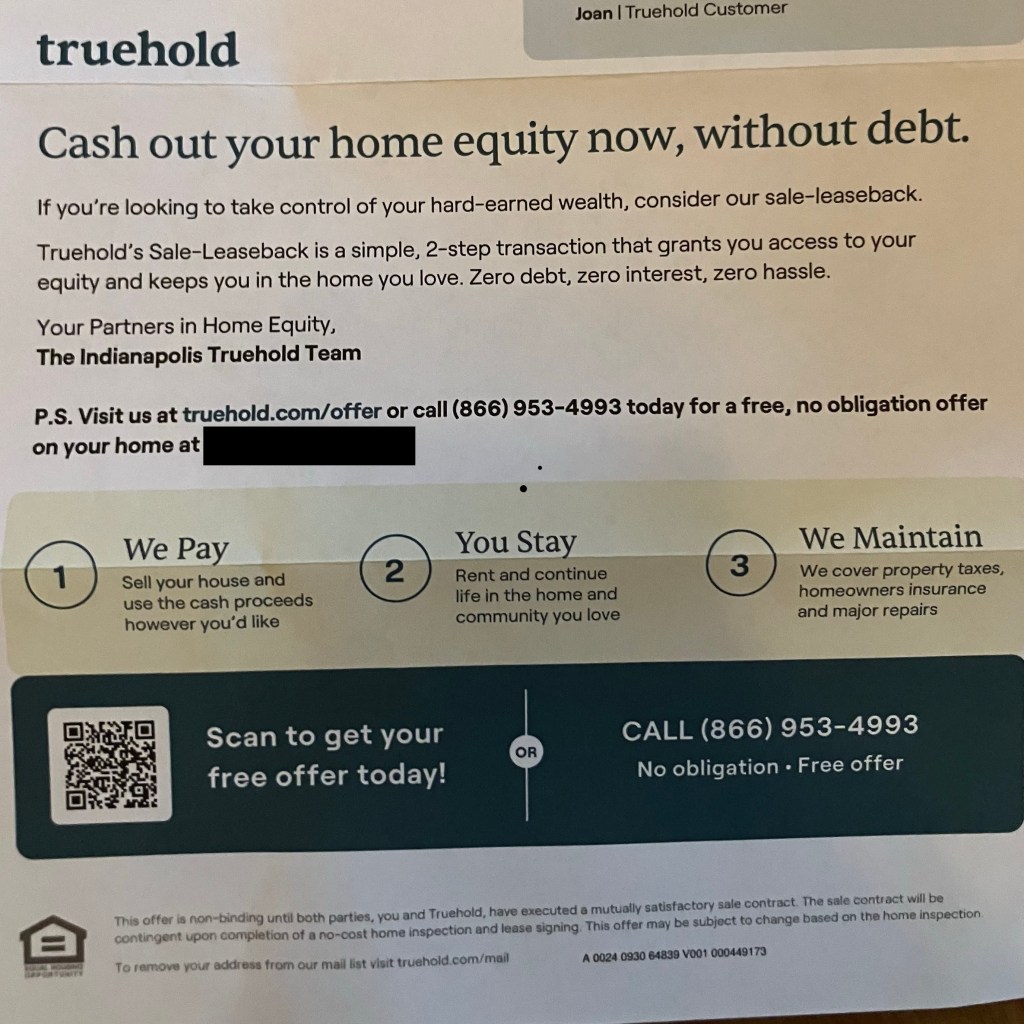
Truehold says their service helps people with “paying off debts, optimizing retirement, and diversifying into income-generating assets.” It’s basically an influx of liquid cash in exchange for the equity in your home. And it’s “debt-free” because you’ll never own your home again. As of 2022, 300 customers had received $50 million in equity for selling their homes to Truehold. That’s an average of $167,000 per home, which seems low.
Prospective customers who have requested quotes from Truehold claim that they were given offers below the home’s fair value. They would be told the house would be bought “as is,” but then after an inspection, Truehold would cancel the purchase, lower the price, or throw in other surprise terms:
they lopped 60k off the price based on the inspection. One of the issues cited was our four year old deck that was built by a licensed contractor and approved by a county inspector. We planned on doing the leaseback program so I asked if the rent could be made lower since the house value was lower. They said no because the work would go back into the house. So then we counter-offered. We needed **** more for the deal to work for us so that we could pay off our debts. They seemed agreeable to that, but the next thing we know they wanted is to sign an agreement to pay a years rent in advance. We were going to have to come to closing PAYING them 7k to buy our house.
Corporate Landlords
If you do go through the entire sale-leaseback process, you then join the plight of renters of investment properties everywhere. We’ve all heard the horror stories from renters:
- Owners allowing the condition of the property to deteriorate
- No response to pleas for necessary repairs
- Raising rents
- Eviction for no reason
My neighborhood is full of properties owned by corporations and individual “property investors.” I always put the term “property investor” in quotation marks because investment implies some form stewardship. An investor maintains the quality of their asset so that it appreciates in value. Someone who hopes to gain value from ownership of an asset without stewardship isn’t really an investor, they are either a speculator or rent-seeker. Stewardship is something you don’t see much of if you go around and look at these “investment” properties. There are trees growing into the roof, seedlings sprouting in the gutters, gutters falling off the house, poison ivy climbing the siding, holes where animals are entering and exiting the attic, etc. And those are just the problems you can see on the outside. A more accurate term than “property investor” is slumlord.
Truehold has not been around long enough for us to have evidence of their quality of care for the properties. I question how long they are even keeping them. I would imagine that a business like this would have an easier time selling the properties to other “property investors,” like many lenders do with mortgages, auto loans, and student loans. Rather than maintain them, it might be easier to sell them to a company already heavily invested in the housing market, say for example… Blackstone.
Nevertheless, getting records of what happens to these properties after the sale-leaseback process is a much deeper dive than I am able to do for this blog post. But if you need some help using your imagination about what happens to these properties after Truehold buys them, just know that Truehold’s founder and CEO, Brian Hardecker, worked from 2015-2021 for… wait for it… Blackstone.
That’s right, the Blackstone that currently holds the 3rd largest portfolio of single-family residences in the United States. Blackstone made a massive investment in the market during the 2008 financial crisis, left the market in 2019, and then returned to it in June 2021. Hardecker worked there from 2015 until March 2021. Truehold’s focus has been on the Midwest, while Blackstone’s tens of thousands of properties are basically everywhere else.
Notice the cycle in Blackstone’s buying process:
- Buy houses when prices are cheap.
- Rent the houses out.
- Sell houses when prices are higher.
- Repeat.
The prices are not higher because Blackstone invested in improving the properties. They are higher because of changes in the market, mostly those created by crises or by government and Federal Reserve economic interventions responding to crises. Again, it’s rent-seeking and speculation.
Warren Buffett said that “someone’s sitting in the shade today because someone planted a tree a long time ago.” But in the case of companies like Blackstone and Truehold, that someone is sitting in the shade of an invasive tree that is growing up the side of a decrepit house. The corporations and governments have colluded to take away American home ownership, and with that loss of ownership has come the loss of stewardship. They’re not just trying to take your home; they’re trying to take the American dream.

 Econ4All